
Background
This paper, and the model it presents, is primarily aimed at researchers to help them refine their understanding of the academic competence (AC) of home educated students. However, the connectivity of the various elements presented in the model might also be useful to the practitioners of home education or organizations that support home educators.
There were four researchers who collaborated on the subject paper: Carlos Valiente, Tracy L. Spinrad, Nancy Eisenberg, and Brian Ray (2024); and they will be hereafter referred to as “the researchers.”
The need for this approach comes from the preponderance of extant research that attempts to compare home-educated students to traditionally schooled children, drawing conclusion based on between-group differences. However, because home education functions outside of many pragmatic paradigms necessary for institutionalized schooling (i.e., daily and yearly schedules, standardized curriculum, age- or ability-grouped classrooms, etc.), there is a need to study home educators independent of comparisons with traditionally schooled students. The goal of this paper is to begin to fill this gap by proposing this model which can guide a next generation of studies designed to understand homeschoolers’ AC.
The researchers identified an incongruence in existing data between the intent of parents to continue home educating long term and other data which shows a large portion of students who are only home education for 1-2 years. The assessment is that there might be “challenges that inhibit learning,” which are not address due to the prevalence of the between-group studies. In-group studies would be necessary to explain such apparent discrepancies.
Methodology
The researchers developed and presented a heuristic (a pragmatic starting place) model “conceptualized to guide research on understanding individual differences in homeschoolers’ AC (broadly defined)” The model is shown below:
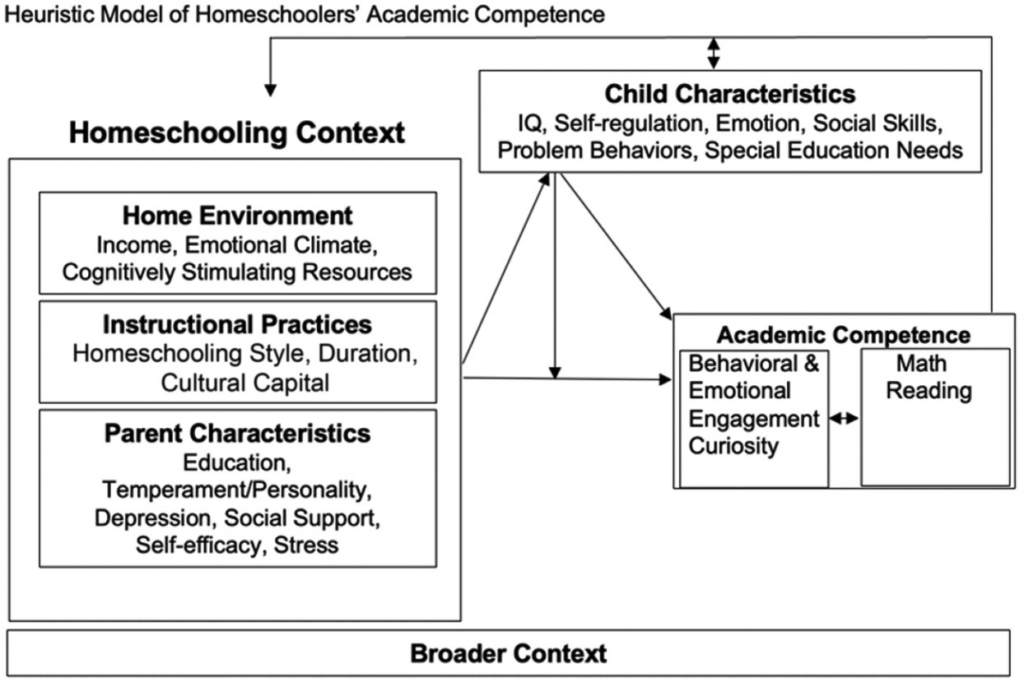
The researchers do not provide an exhaustive discussion of each element of this model as it is a starting point for future research. The discussions of the elements are focused on elementary age students as this is shown in the literature to be a particularly relevant timeframe for influence on academic achievement. The researchers focused on the roles of several domains (i.e., home environment, instructional practices, parent characteristics) with the role of child characteristics viewed as a moderator for each of the other domains and the resultant impact on AC.
Theoretical Framework
This model establishes a theoretical framework for evaluating the AC of home educated students while taking into consideration that the broader context can impact the entire model or individual elements of the model. The broader context is described using literature-based descriptions of “microsystem (i.e., family, peers, church), mesosystem (i.e., the ways that features of the microsystem interact), exosystem (i.e., neighbors, local politics), macrosystem (i.e., cultural values), and chronosystem (i.e., changes over time).”
Findings and Recommendations
The point of this paper wasn’t to draw immediate generalizable findings, but to set up researchers to be able to analyze future data with this construct. This model will need to be tested, and the researchers made several recommendations for how to accomplish this.
- The model needs to be examined via a within-group design. Rather than using schooling metrics, such as standardized test scores, researchers can focus on AC influences that are unique to the home education paradigm.
- Investigators should collect multi-method/reporter data to reduce shared reporter and method bias. Researchers could use existing instruments in combination with observational data or develop new instruments intended to elicit data which can be analyzed with this model.
- Longitudinal data are needed. This would provide data to correlate the impact on AC in relation to changes in the home education environment within the given domains.
- Diverse samples should be studied. This would include diversities in ethnicity, geography (rural, urban, suburban), and family configuration (single-parent homes, two-parent homes, one-parent instruction, dual-parent instruction, etc.).
Conclusion
As this paper suggests, the heuristic model of homeschoolers’ academic outcomes is a novel but necessary theoretical framework which can be used to guide the formation of future studies and to analyze the data collected from them. With time and usage, this model might prove a valuable tool for filling the existing gap in the literature on the efficacy of home education and providing necessary analysis for political decision-makers, schools of education that are expanding their focus to include home education, and new or existing home education support organizations.
Practitioners of home education can also make use of this model to help them understand the complex interconnectivity of the given domains and their influence on a student’s AC.
NHERI Comment
The senior researcher of NHERI is a contributing author to this paper.
References
Valiente, Carlos; Spinrad, Tracy L., Eisenberg, Nancy; and Ray, Brian (2024). A Heuristic Model to Guide the Study of Homeschoolers’ Academic Competence. Journal of School Choice, 18(4) pp. 668-682. DOI: 10.1080/15582159.2024.2422249