
Brian D. Ray, Ph.D.
Douglas Pietersma, Ed.D.
National Home Education Research Institute (NHERI)
March 10, 2026
Copyright © National Home Education Research Institute
Summary – Homeschool Academic Achievement: Key Facts and Points to Discuss
Big Picture on Homeschool Research
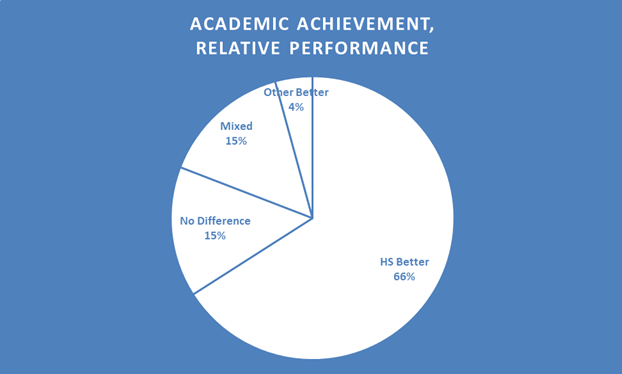
- Over 30+ years, 62% (15 of 24) peer-reviewed and/or representative-sample studies show homeschool students outperforming institutional school peers on academic tests; a few have mixed or negative results.
- Neither scholars nor advocates claim homeschoolers always excel or that research proves causation—focus is on consistent positive trends.
- Homeschooling prioritizes family values, morals, religion, and holistic development over test scores.
- Standardized tests are limited, designed for institutional schools, and may not validly measure homeschool goals; homeschoolers aren’t required to teach to them.
- Other indicators of success and lifelong learning may matter more than test scores.
- Critics like CRHE (2025, 2026), Bartholet (2020), Dwyer & Peters (2019), Kunzman (2009), West (2009), Fineman & Shepherd (2016), Ross (2010), and Yuracko (2008) overemphasize tests, to push government control (regulation) or bans of homeschooling, but their analyses often lack rigor, balance, or peer review.
- No evidence shows increased government control improves homeschool outcomes or society more than parental freedom in choices for children’s education.
Debunking Claims of “Flawed” or “Debunked” Studies
- Studies showing strong homeschool performance are not “debunked”—social science studies have limitations that scholars openly discuss.
- CRHE falsely claims debunking, relying on non-scholarly sources like an old Gaither blog and their own posts.
- Positive findings from various scholars’ studies remain valuable despite selective critiques.
Addressing Sampling Concerns
- Random/representative samples are rare across all K-12 education research due to cost and logistics—not unique to homeschool studies.
- Homeschoolers are a hard-to-reach population, like rural elderly or LGBTQ+ youth, making perfect sampling challenging but not invalidating research results.
- CRHE’s claim of over-representing “white, wealthy, religious, highly educated” families is exaggerated; studies show diversity in income, education, and growing representation in race/ethnicity.
Correlation vs. Causation: What the Research Really Says
- Researchers clearly distinguish correlation from causation and avoid over-claiming homeschooling as a sole cause.
- Background factors matter, but many studies control for them; 35 years of positive associations suggest homeschooling may contribute to higher achievement.
Controlling for Background Variables
- Many homeschool studies control for income, race, and education—contrary to critics’ claims.
- Even with controls, homeschoolers often score above average.
Homeschool Success: What Even Critics Admit
- CRHE and Kunzman & Gaither admit homeschoolers can excel, but apparently attribute it only to family factors.
- Causation is not proven (rare in social sciences), but research has not ruled out homeschooling as a positive driver or cause.
- Poor outcomes occur in any system; overall evidence favors homeschool strengths.
The So-Called “Math Gap”: Fact vs. Fiction
- Homeschoolers score above average in math; claims of a consistent “gap” are false and not properly documented or cited by CRHE.
- Sources like Belfield, Qaqish, and McCracken & Coleman show minimal or no significant differences or study public programs (McCracken & Coleman) —not true homeschooling.
- Kunzman & Gaither overstate verbal-math disparity; at most, there is a slight relative difference in math, but still strong overall.
College Attendance and Performance
- Mixed findings on college value and attendance; some subgroups show fewer years of college, but overall rates match or exceed general population.
- Ray representative sample: associate’s (9.8%), bachelor’s (33.1%), master’s (10.2%), doctoral (2.1%).
- CRHE’s “far lower” claim is overstated; varies by homeschool duration (Cheng & Watson); homeschoolers who attend perform well.
Educational Neglect: Unsubstantiated Claims
- There is virtually no research on educational neglect in homeschooling.
- CRHE citations use inconclusive self-reports; their 2014 survey (25% reporting neglect) lacks representativeness—contradicting their own sampling critiques.
- Flexibility often helps kids catch up or learn personally.
How Critics Portray Homeschooling—and Why It Matters
- Critics hesitate to credit homeschooling positives, emphasizing negatives to justify control; no one claims “universal” superiority—that is a straw man.
- Even test-score parity for homeschool vs. others would highlight efficiency: equal results without certified teachers, $19,000+ per-student tax dollars, or state-approved curricula.
- Regression toward mean possible as homeschooling grows, but trends currently favor homeschoolers.
Key Takeaways
- Homeschooling delivers strong academics for many—this favors parental freedom with evidence of balance and efficiency.
- One should acknowledge research limitations (common to most education studies) and diversity in homeschooling.
- Forty years of research shows holistic benefits of homeschooling.
- There is no empirical body of evidence that government regulation improves outcomes.
- Evidence is that homeschool families should be commended, empowered, and free.
Full-Length Overview
The Big Picture
Studies by many different scholars from over 30 years of research on homeschool students’ academic achievement show that 62% (15 of 24) of peer-reviewed and/or representative-sample studies have revealed a positive effect for the homeschooled students compared to institutionally schooled students, while a few studies have shown mixed or negative results (Ray, Hoelzle, & Pietersma, 2026; Ray, 2017). Neither scholars nor homeschooling advocates claim that home-educated students always academically excel others or that research has settled the question of whether homeschooling generally causes students to perform better.
Who is Preoccupied with Test Scores and Academics?
- Perhaps some negative critics of what research shows or groups who want the civil government (state) to lay more controls on private homeschooling put too much emphasis on homeschoolers’ achievement test scores or on academic learning overall (e.g., Bartholet 2020; Coalition for Responsible Home Education (CRHE), 2025, 2026; Dwyer & Peters, 2019; Kunzman, 2009; Kunzman & Gaither, 2020; Ross, 2010; Yuracko, 2008). Maybe they are overly preoccupied with test scores and other measures of academic learning. Homeschool parents generally are not. Parents choose homeschooling for a wide variety of reasons. Solid academic achievement in reading, writing, mathematics, science, and social studies is only one reason among many. According to various studies (e.g., Fields-Smith & Baker, 2023; Ray & Hoelzle, 2026; U.S. Department of Education, 2024), parents give several reasons for homeschooling that are more important to them than academic education or test scores.
- Further, standardized academic achievement test scores are only one way to assess or evaluate learning. They are not necessarily the best or most appropriate way. And homeschoolers are not required to teach to these tests.
- CRHE’s (2025) article is not a scholarly and peer-reviewed review of research literature on achievement test scores. It lacks important citations and fitting analysis. Being in a peer-reviewed journal is not necessary for an article to be considered high quality, but this is simply a fact to consider.
- Bartholet’s article is not a scholarly review of empirical research, and “… contains a number of assertions about homeschooling that are clearly undermined by the facts and unsupported by her sources” (Wolf, Lee, & Watson, 2020).
- Kunzman and Gaither’s article (a) includes the fallacy of poisoning the well, (b) lopsidedly analyzes the funding sources of research projects, (c) creates confusion and misleads by mixing government-run correspondence schooling with homeschooling, (d) spends much time on the importance of having representative-sample studies but then makes no mention that one study that they emphasize (Knox et al., 2014) and a database they report (by CRHE, 2025) are not based on representative samples.
- Dwyer and Peters (a) do not provide a scholarly review of empirical research, (b) refer to “… its [homeschooling] baleful effects on children’s intellectual development” (p. 89) but offer no empirical evidence to support this claim, (c) make inaccurate claims about who does research on homeschooling and what is cited (p. 99), and (e) apparently select only one study (i.e., cherry pick) – that does not report a statistical difference between the homeschooled and non-homeschooled – to make a negative claim about homeschool students who intend to attend college (that is apparently mentioned in another person’s article, p. 99).
Figure 1. Percent of studies on academic achievement showing an advantage or not for the homeschooled. Sixty-two percent (15 of 24) of peer-reviewed and/or representative-sample studies show homeschool students outperforming institutional school peers on academic tests; a few have mixed or negative results.***
***Findings are from Ray, Hoelzle, & Pietersma (2026, in press). Draft only, not for reproduction without express permission from Brian Ray.
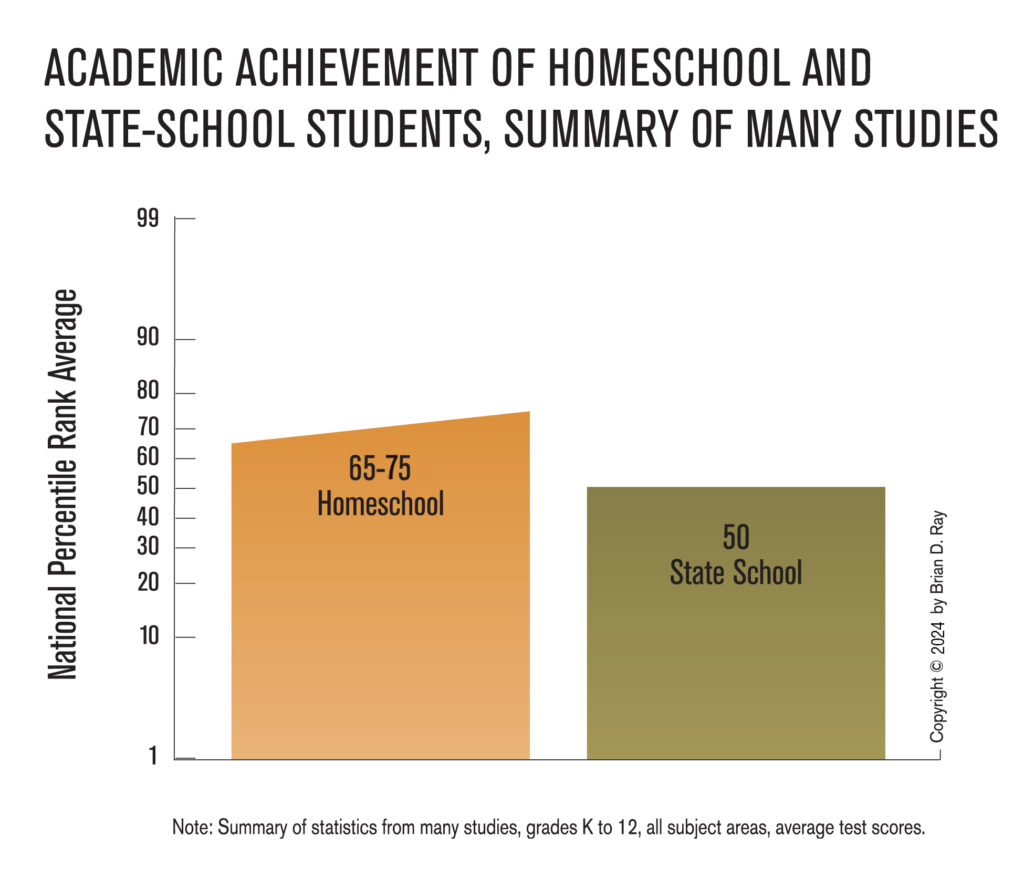
Figure 2. Achievement test scores, on average, of homeschooled and public school students.
Are Studies Showing the Homeschooled Perform Well on Tests De-bunked?
Some critics of homeschool research or organizations who focus on promoting more government (state) control of private homeschooling claim or imply that many scholarly studies offer little or no scientific information. For example, CRHE (2025) wrote:
“A very common claim in conversations about homeschooling is that research proves homeschooled students perform better on standardized tests than their peers in school. This claim, however, is based on a few well-known studies that scholars have repeatedly debunked [link] as unsound. CRHE has published in-depth reviews of these studies and their shortcomings (here, here, here, and here [links]). Zooming out, we can look at recurring issues with these studies, examine the current state of homeschool research, and apply better practices to work moving forward.”
- This claim is false.
- The studies to which CRHE’s (2025) citations refer have not been “debunked.” Most studies in social science fields have limitations that scholars discuss and debate as they consider what the studies can and cannot tell us.
- CRHE (2025) cites a 16-year-old blog post by Gaither. It is not an article in a scholarly journal. Gaither is and was not a quantitative researcher or methodologist. He left out important points and showed his biases. He is no longer involved in research on homeschooling or academia.
- CRHE (2025) then cites their own in-house blog posts four times, and not scholarly journal sources. Being in a scholarly journal is not necessary for good logic and analysis but it is something to keep in mind.
- Those who make errors like CRHE (2025) and Gaither should read
“What is “good” research? A homeschool researcher responds to Harvard professor’s criticism: Research methods 101” (Ray, 2020).
The Random or Representative Sample Issue
Various critics of research and others who want the government to control homeschoolers more talk about random or representative samples in studies. And this is an important topic.
For example, CRHE (2025) wrote:
“The studies don’t rely on random samples. Researchers recruited their participants by asking for volunteers within their networks — not by using random sampling. This means that their samples are not representative of homeschooled students as a whole, and that their conclusions cannot apply to all homeschooled students. In fact, the studies overwhelmingly overrepresented white, wealthy, religious, highly educated homeschooling families.”
- Their claim has mixed accuracy; some of it is false.
- Very few research studies in K-12 education rely on random samples (e.g., AI summary on topic).
- This is a limitation of much research; it is not a flaw. It is not a reason to ignore the research studies’ findings.
- Researchers must do the best they can with the best data that they can get.
- In addition, hard-to-reach populations (e.g., elderly people in rural areas, Roma people/gypsies, patients with rare diseases, and LGBTQ+ youth) are even more difficult to study with random or representative samples, and scholars consider homeschoolers to be a hard-to-reach population.
- It is false to claim, “… the studies overwhelmingly overrepresented white, wealthy, religious, highly educated homeschooling families.” Multiple studies (e.g., Ray & Hoelzle, 2026; Ray, 1990, 2000; Rudner, 1999) do not find the families “wealthy” and it is exaggeration to say they were “highly educated.” Further, CRHE does not know what traits a representative sample would have. The U.S. homeschool population is becoming more representative in terms of ethnicity/race and parent education level and is apparently including a more disproportionately lower-income makeup.
Do Researchers Understand Correlation Versus Causation?
Some negative critics of homeschool research or groups individuals who want the government to control homeschooling more claim that people are confused about correlation and causation. CRHE (2025) claims the following:
“They confuse correlation and causation. Even when a study finds that homeschooled students have higher test scores, researchers cannot automatically conclude that homeschooling is causally responsible for these outcomes. Parent education level or a family’s access to resources could potentially be responsible. The studies in question do not account for these variables.”
- It is a false claim that, “They confuse correlation and causation.” Neither the research scholars nor the studies and articles they write “confuse correlation and causation.” For example, all of the following scholars and their papers recognize the difference between correlation and causation and how to apply it to their findings:
Cogan (2010)
Guterman & Neuman (2019)
Rudner (1999)
Ray (1990, 2000, 2010)
Ray & Hoelzle (2026)
Martin-Chang et al. (2011)
- 2. It is misleading or false to claim “Parent education level or a family’s access to resources could potentially be responsible. The studies in question do not account for these variables” without citing specific studies. Further, many studies do account for confounding variables (see next section).
Do Researchers Control for Important Background Variables?
It is true that to compare two groups it is important to statistically control for background factors or variables. Things like family income, parent education level, and ethnicity/race, just as do scholars studying public school students.
But some scholars critiquing homeschool research (e.g., Bartholet, 2020; Kunzman & Gaither, 2020) or individuals or organizations who want the government to control homeschooling more (CRHE, 2025) speak and write as if those who do studies on homeschooling do not understand statistical controls. For example, CRHE (2025) claimed the following:
“They don’t control for other background factors. To truly compare homeschooled students’ performance to their peers in school, researchers would need to recruit participants from both groups that have similar backgrounds. Otherwise, they cannot isolate homeschooling as the only factor influencing performance.”
- This is False.
- Several scholars and their published articles have controlled “for other background factors” (e.g., parent education level, family income, ethnicity/race).
- These scholars fully understand that solid research methodology attempts to control all the variables, but often cannot. Examples of scholars who have controlled variables follow here:
Boulter (2017)
Cogan (2010)
Guterman & Neuman (2019)
Martin-Chang et al. (2011)
Mwanyumba et al. (2022)
Qaqish (2007)
Ray (2010)
Ray & Hoelzle (2026)
Treleaven (2022)
Do Negative Critics of Homeschool Research and Organizations Who Want to Control Homeschooling More Admit that Homeschoolers Can Achieve Well?
Yes, sometimes organizations and authors such as CRHE (2025) and Kunzman and Gaither (2020) admit that some or many homeschool children do well academically. For example, CRHE (2025) wrote the following:
“Credible research on homeschooling shows that homeschooled students can perform very well academically. Academic achievement, however, is known to be influenced by factors like a parent’s level of education or the family’s socioeconomic status, which reflect the amount of educational resources children have available to them. This means that, while evidence shows homeschooling can lead to academic success, that success cannot necessary [sic] be attributed to homeschooling.”
However, CRHE’s statement here has some problems, as follows.
- It is mixed in accuracy.
- It is true that, “Credible research on homeschooling shows that homeschooled students can perform very well academically.”
- It is true that various background variables statistically explain academic achievement in institutional school settings.
- It is true that the academic success related to homeschooling has not been decisively shown to be “attributed to homeschooling,” that is, caused by homeschooling.
- The whole story, however, is that very few relationships in social science research are conclusive about causation (as compared to correlation).
- Further, it is false or misleading to imply that research shows that homeschooling does not cause academic success. That is, homeschooling may cause higher-than expected academic achievement. This has not been ruled out by research.
Do Homeschool Students Exhibit a “Math Gap”?
Overall, homeschool students score above average on math tests. However, a few critics of homeschool research (e.g., Kunzman & Gaither, 2020) or organizations or individuals that want the government to control homeschooling more or ban homeschooling (e.g., Bartholet, 2020; CRHE, 2025, 2026; Fineman & Shepherd, 2016) allude to or claim that homeschooling harms children’s math achievement. For example, CRHE (2025) claimed the following:
“The math gap. When family background is controlled for, studies have consistently shown that homeschooled children, on average, perform worse in math than their peers in school. While no one is sure what the cause of the so-called math gap is, some speculate that it is due to the fact that homeschooling is usually reading-intensive, and that homeschooled parents tend not to be as experienced in math (or the teaching of math) as other subjects.”
- This is false.
- Notice that CRHE (2025) does not cite sources to support their claim.
- The sources that CRHE (2025) and others (e.g., Kunzman & Gaither, 2020) often cite to promote this false statement are as follow, with NHERI’s comments:
- Belfield (2004, 2005). His study deals with students who are going on to college and not general K-12 achievement. Both of these articles report on the same data, and neither are in peer-reviewed journals. Belfield does not state that the non-homeschooled do statistically significantly better than the homeschooled.
- Qaqish (2007). His study deals with students who are going on to college and not general K-12 achievement. Qaqish found very small differences, practically speaking, between the homeschooled and institutionally schooled in math.
- McCracken & Coleman (2020). This is not a study of homeschool students but of students in government/public-school-at-home programs. CRHE (2025) misleadingly cites this as homeschool research.
- Kunzman and Gaither (2020) make the baseless and misleading claim that, “… we might conclude, tentatively, that there may be at least a modest homeschooling effect on academic achievement— namely that it tends to improve students’ verbal skills and weaken their math capacities” (p. 271), but a careful analysis of the studies they cite (e.g., Belfield; McCracken & Coleman; Qaqish, see above) does not support this claim.
- On a note related to credibility, Kunzman & Gaither (2020) commit the fallacy of poisoning the well multiple times regarding the funding of research, and make false statements about NHERI (including who has funded NHERI’s research). They also commit the fallacy of special pleading (or of selective disclosure and/or cherry picking) several times regarding whose studies where funded by whom. This is inequitable, questionable research practice (QRP), and anti-scholarly. In addition, although they claim or imply that NHERI publishes only research favorable to homeschooling, they fail to mention that the Qaqish study they readily cite (as Quaqish [sic]) as supporting their claim of harm to homeschoolers’ math learning, was published in the peer-reviewed journal Home School Researcher of which Brian Ray is editor-in-chief and which NHERI houses and publishes.
- CRHE commits the fallacies of the straw man and selectively picking sources (i.e., cherry picking) to support their claim. This is not a scholarly review of all research studies on math.
- Kunzman and Gaither (2020) also stated, “A second consistent finding of these studies over the past 30 years is that homeschoolers tend to perform better on verbal tests than they do on mathematics assessments” (p. 271). This is closer to the truth than their claim mentioned immediately above.
- Kunzman and Gaither’s (2020) summary should be that the homeschooled might not score as high in math as in reading and language with confounding variables controlled, but it is inaccurate or misleading to claim that homeschooling “… weaken[s] their math capacities.”
- Further, it is possible that homeschool parents do not emphasize mathematics learning, overall, as much as they do the language arts, science, and history or social studies. Research could address this.
At What Rate do Home-Educated Students Go on to College and How Do They Fare There?
There are mixed research findings about to what degree the home educated value or want to attend college, the rate at which they attend college, and how they fare if they attend college. However, some critics of homeschool research or those who want the government to control homeschooling more over-simplify the situation. For example, CRHE (2025) wrote the following:
“Low college attendance. While research suggests that homeschooled students generally perform well if they attend university, the best evidence we have from two randomized studies from 2015 and 2025 suggests that homeschooled students may attend college at far lower rates than peers. More research on this subject is needed.”
- This is mixed accuracy.
- There are mixed findings in studies about how important going to college is to the homeschooled versus the institutionally schooled.
- It is true that in the two studies CRHE (2025) cites, certain sub-groups of homeschoolers completed fewer years of college in their young adult years than did other adults.
- The report from Cardus (Casagrande et al., 2019), however, focuses on religious homeschooling rather than all homeschooling. Therefore, it is difficult to generalize about homeschooling and years of formal education (e.g., college attendance).
- CRHE (2025) does not cite Ray (2022) that involved a representative nationwide sample of adults. In that study, “… 9.8% [of the home educated] have an associate’s degree, 33.1% have a bachelor’s degree, 10.2% have a master’s degree, and 2.1% have a doctoral degree,” which was at least as high a rate of post-secondary education as the general population.
- Cheng and Watson (2025) found that how the homeschooled compared to others regarding rates of college degrees varied by whether they were short-term, medium-term, or long-term homeschoolers.
- Research studies overall do not show, as CRHE (2025) claims, that homeschooled students are “… attend[ing] college at far lower rates …”
Are Homeschooled Children Educationally Neglected?
Some negative critics of homeschooling (Bartholet, 2020; West, 2009) or organizations who lobby the government to control homeschooling more (CRHE, 2025) make claims about educational neglect. For example, CRHE makes the following claim:
“Educational neglect. Little research has been conducted on educational neglect in homeschool settings, but a study of national data found that homeschooled children were two-to-three times more likely to report being behind grade level than peers. This does not necessarily mean that homeschooling itself led to these poor outcomes: students might have been behind before homeschooling occurred. Moreover, educational neglect is an experience commonly cited in homeschool alumni circles, which is reflected in results from a 2014 survey of over 3,700 homeschool alumni that found that nearly one quarter of respondents indicated that they experienced educational neglect or abuse.”
- CRHE here is misleading and self-contradictory.
- It is not that “little research has been conducted on educational neglect” but, rather, essentially none has been done.
- Green-Hennessy (2014) has nothing to do with whether any homeschooled students are educationally neglected. Further, self-reporting about perceived grade level by students (some of whom were homeschooled less than one year) tells us almost nothing.
- It is true, as CRHE states about Green-Hennessy (2014), but even CRHE’s wording here is misleading: “This does not necessarily mean that homeschooling itself led to these poor outcomes: students might have been [self-perceived as] behind before homeschooling occurred.”
- CRHE damages their own credibility here. Citing their own survey that was not a random or representative sampling of homeschoolers is contrary to all their criticisms of non-random and non-representative samples in research on homeschooling. To the best of our knowledge, CRHE’s reports on their own “2014 survey” have never gone through outside scholarly review or been published in scholarly journals, peer-reviewed or otherwise.
How Do Negative Critics of Research and Pro-Controllers of Homeschooling Portray Homeschool Achievement?
It appears that some negative critics of research and groups who want the government to control homeschooling more are reticent to say that homeschooling can cause good things, and they spend disproportionate space on how homeschool students may do no better or even worse than public school students. For example, CRHE (2025) concluded the following:
“KEY TAKEAWAY. While evidence shows that homeschooling can create great academic success, claims that homeschooled students universally perform better than their school-educated peers are baseless. Evidence from peer-reviewed studies, and the testimonies of homeschool alumni, also demonstrate that homeschooling can lead to poor outcomes for homeschooled children. Both of these realities need to be acknowledged in debates about homeschooling’s effectiveness.”
- Their “takeaway” exhibits mixed accuracy.
- It is true that “… homeschooling can create great academic success …”
- It is misleading in that we do not know of any scholar, layperson, or organization that claims “… homeschooled students universally perform better than their school-educated peers …” CRHE (2025) does not provide citations showing when or where anyone has actually made this claim.
- It is true “… that homeschooling can lead to poor outcomes for [individual] homeschooled children.” The same is true for public-school or private-school children.
- In many areas of social science research (including education), it is hard to say that there are conclusive causal effects of this or that treatment or practice. The topic of homeschooling’s effect on academic achievement is no different.
- However, when the 35-year-old body of research consistently finds positive things related to homeschooling, especially compared to public schooling, there is a strong possibility that homeschooling causes the positive differences.
Big Picture Summary
- Academic achievement or learning as measured by standardized tests is not the main reason that most parents choose homeschooling for their children.
- Homeschool students do not need (e.g., philosophically, legally, or politically) to perform better, academically, than do institutional school children, once all background variables are controlled.
- Standardized academic achievement tests are designed for institutional school systems, not for homeschoolers. These tests might not be valid and reliable for measuring whether any particular homeschool family’s or teens’ learning objectives are being met (Cizek, 1993; Neuman & Guterman, 2016).
- Standardized tests are of limited worth for measuring learning.
- Public-school and private-school students generally have more experience than homeschool students taking standardized tests.
- However, most studies do find that home-educated students outperform public school students on standardized tests.
- Children around the world share the same fundamental mental, emotional, and learning processes, responding similarly to effective teaching methods and having comparable academic and social needs across cultures. U.S. research demonstrating strong overall academic performance and test scores among K-12 homeschool students therefore applies broadly to homeschoolers globally. Limited international studies also confirm positive outcomes for home-educated children. Universal homeschool strengths—personalized pacing, one-on-one instruction, flexible curricula, and lower peer pressure—yield similar educational gains regardless of country. Thus, U.S. evidence provides reliable, transferable confirmation of homeschooling’s worldwide potential.
- There is no body of empirical research evidence from any nation that shows more government (state) control over homeschooling improves matters for children.
- Over the years, it is possible that regression toward the mean will be seen in the test scores of homeschool students. Ray (2010) noted this at least 16 years ago.
- If someday the perfect study were to be conducted (e.g., all background variables are statistically controlled; perfectly representative samples obtained) and there were found to be no difference between the test scores of the homeschooled and others, that would still be a big story, big news. That is, the homeschooled did just as well without (a) state-licensed teachers, (b) university-trained teachers, (c) $19,000 in tax dollars per year (National Education Association, 2025), (d) tax-funded research and development by university education professors, and (e) state- and professionally approved curriculum.
- Maybe individuals and groups like Bartholet (2020), CRHE (2025, 2026), Dwyer and Peters (2019), and Kunzman and Gaither (2020) should not be so concerned about whether the home educated or the public schooled score better than the other on standardized academic achievement tests.
- Maybe other indications of academic learning, academic success, and interest in lifelong learning are more important than test scores.
- There is no research or empirical evidence that more government control over homeschooling – such as is promoted by Bartholet (2020), CRHE (2025, 2026), Dwyer & Peters (2019, Ch. 7), Kunzman (2009), Ross (2010), West (2009), and Yuracko (2008) – will improve the academic learning of homeschool students, or advance the good of the United States more than does reduced or no civil government control over private homeschooling.
- Scholars and advocacy groups who argue for more government (state) control (regulation) of homeschooling are generally working from a statist worldview and they typically do not divulge their philosophical assumptions or presuppositions.
References
Bartholet, Elizabeth. (2020). Homeschooling: Parent rights absolutism vs. child rights to education and protection, Arizona Law Review, 62(1) (2020).
Belfield, Clive R. (2004). Home-Schooling in the US. Occasional Paper No. 88 from the National Center for the Study of Privatization in Education Teachers College, Columbia University. New York, NY: National Center for the Study of Privatization in Education Teachers College, Columbia University. https://www.researchgate.net/publication/228426754_Occasional_Paper_No_88_National_Center_for_the_Study_of_Privatization_in_Education_Teachers_College_Columbia_University
Belfield, Clive R. (2005). Home-schoolers: How well do they perform on the SAT for college admission? In Bruce S. Cooper (Ed.), Home schooling in full view: A reader, Chapter 11, p. 167-177. Greenwich, CT: Information Age Publishing.
Boulter, Lyn T. (2017). A Comparison of the academic achievement of home school and public school students. International Journal of Business and Social Research, 07(03), ISSN 2164-2559. https://core.ac.uk/download/pdf/208833446.pdf
Casagrande, Marisa; Pennings, Ray; & Sikkink, David. (2019). Rethinking public education including all schools that contribute to the public good. https://www.cardus.ca/research/education/reports/rethinking-public-education/
Cheng, Albert; & Watson, Angela. (2025). Diverse outcomes for a diverse population: Findings about homeschooled adults from the Cardus Education Survey. https://www.cardus.ca/research/education/reports/diverse-outcomes-for-a-diverse-population/
Cizek, Gregory J. (1993). The mismeasure of home schooling effectiveness: A commentary. Home School Researcher, 9(3), 1-4. https://nheri.org/home-school-researcher-the-mismeasure-of-home-schooling-effectiveness-a-commentary/
Coalition for Responsible Home Education (CRHE). (2025). The test score myth and homeschooled students’ academic performance. https://mcusercontent.com/89d5e9e2c3c3a1dbb77b9dae5/files/963084f7-d2ef-0517-bdb1-7049916dd101/The_Test_Score_Myth_and_Homeschooled_Students_039_Academic_Performance_.pdf?mc_cid=675b548139 (see also the undated version at https://crhe.org/research/the-test-score-myth/)
Coalition for Responsible Home Education (CRHE). (2026). What research actually tells us about homeschooling, by Madolyn Henderson, Jonah Stewart, & Elizabeth Bartmess. https://mcusercontent.com/89d5e9e2c3c3a1dbb77b9dae5/files/21c30bdb-e45c-469e-e013-5121edf3f813/2.24_CRHE_Research_Brief.pdf
Cogan, Michael F. (2010). Exploring academic outcomes of homeschooled students. Journal of College Admission, 208, 18‑25.
Dwyer, James G.: & Peters, Shawn F. (2019). Homeschooling: The history and philosophy of a controversial practice. Chicago, IL: University of Chicago Press.
Fields-Smith, Cheryl, & Baker, Timberly L. (2023). Centering the lived experiences of rural Black homeschool families. Thresholds in Education, 46(3). link.gale.com/apps/doc/A781611308/AONE
Fineman, Martha, & Shepherd, George B. (2016). Homeschooling: Choosing parental rights over children’s interests. University of Baltimore Law Review, 46(1), 57-106.
Green-Hennessy, Sharon. (2014). Homeschooled adolescents in the United States: Developmental outcomes. Journal of Adolescence 37, 441-449.
Guterman, Oz. & Neuman, Ari. (2019). Reading at home: Comparison of reading ability among homeschooled and traditionally schooled children. Reading Psychology, 40,169-190. https://www.tandfonline.com/doi/abs/10.1080/02702711.2019.1614123
Knox, Barbara L; Starling, Suzanne P.; Feldman, Kenneth W.; Kellogg, Nancy D.; Frasier, Lori D.; & Tiapula, Suzanna L. (2014). Child torture as a form of child abuse. Journal of Child & Adolescent Trauma, 7(1), 37-49.
Kunzman, Robert. (2009). Understanding homeschooling: A better approach to regulation. Theory and Research in Education, 7(3), 311-330.
Kunzman, Robert, & Gaither, Milton. (2020). Homeschooling: An updated comprehensive survey of the research. Other Education: The Journal of Educational Alternatives, 9(1), 253-336. https://www.othereducation.org/index.php/OE/article/view/259
Martin-Chang, Sandra; Gould, Odette N.; Meuse, Reanne E. (2011, July). The impact of schooling on academic achievement: Evidence from homeschooled and traditionally schooled students. Canadian Journal of Behavioural Science/Revue canadienne des sciences du comportement, 43(3), 195-202.
McCracken, Chelsea, & Coleman, Rachel. (2020). A meaningful measure of homeschool academic achievement: Statistical analysis of standardized test performance in Alaska public correspondence schools. Other Education: The Journal of Educational Alternatives, 9(1), 207-252. https://www.othereducation.org/index.php/OE/article/view/258
Mwanyumba T. F., Wamocha, L., & Buhere, P. (2022). Academic outcomes of homeschooled versus conventionally schooled children pursuing the Accelerated Christian Education curriculum in Kenya. Problems of Education in the 21st Century, 80(3), 474-486.
National Education Association. (2025). Rankings of the states 2024 and estimates of school statistics 2025. NEA Research. https://www.nea.org/sites/default/files/2025-04/2025_rankings_and_estimates_report.pdf
Neuman, Ari; & Guterman, Oz. (2016). Academic achievements and homeschooling—It all depends on the goals. Studies in Educational Evaluation, v. 51, pp. 1–6. https://www.sciencedirect.com/science/article/abs/pii/S0191491X16300566
Qaqish, Basil. (2007). A comparison of home schooled and non-home schooled students on ACT mathematics achievement test. Home School Researcher, 17(2), 1-12. https://nheri.org/home-school-researcher-an-analysis-of-homeschooled-and-non-homeschooled-students-performance-on-an-act-mathematics-test/
Ray, Brian D. (1990). A nationwide study of home education: Family characteristics, legal matters, and student achievement. Salem, OR: National Home Education Research Institute, www.nheri.org.
Ray, Brian D. (2000). Home schooling: The ameliorator of negative influences on learning? Peabody Journal of Education, 75(1 & 2), 71-106. https://www.tandfonline.com/doi/abs/10.1080/0161956X.2000.9681936
Ray, Brian D. (2010). Academic achievement and demographic traits of homeschool students: A nationwide study. Academic Leadership Journal, 8(1). https://scholars.fhsu.edu/alj/vol8/iss1/7/
Ray, Brian D. (2020). “What is “good” research? A homeschool researcher responds to Harvard professor’s criticism: Research methods 101. https://nheri.org/what-is-good-research-a-homeschool-researcher-responds-to-harvard-professors-criticism/
Ray, Brian D. (2022). The transmission of culture, religion, and affinity for four school choices to adults who were homeschooled, public schooled, and private schooled, NHERI Working Paper 2022-02a. https://papers.ssrn.com/sol3/papers.cfm?abstract_id=4046167
Ray, Brian D.; & Hoelzle, Braden. (2026, in press). A nationwide study on the academic achievement of homeschool students and parents’ reasons for homeschooling.
Ray, Brian D.; Hoelzle, Braden; & Pietersma, Douglas. (2026, in press). A systematic review of the empirical research on selected aspects of homeschooling: Updated.
Ross, Catherine. (2010). Fundamentalist challenges to core democratic values: Exit and homeschooling. William and Mary Bill of Rights Journal, 18 (May 2010), 991-1014.
Rudner, Lawrence M. (1999). Scholastic achievement and demographic characteristics of home school students in 1998. Educational Policy Analysis Archives, 7(8). https://epaa.asu.edu/index.php/epaa/article/view/543
Treleaven, Lisa M. (2022). Quantitative insights into the academic outcomes of homeschools from the Classic Learning Test. Home School Researcher, 38(1), 1-13. https://nheri.org/quantitative-insights-into-the-academic-outcomes-of-homeschools-from-the-classic-learning-test/
United States Department of Education. (2024). Parent and Family Involvement in Education: 2023, First Look. https://nces.ed.gov/pubs2024/2024113.pdf
West, Robin L. (2009, Summer/Fall). The harms of homeschooling. Philosophy and Public Policy Quarterly, 29(3/4), 7-12. https://philpapers.org/rec/WESTHO-6
Wolf, Patrick J.; Lee, Matthew H.; & Watson, Angela R. (2020). Harvard law professor’s attack on homeschooling is a flawed failure. And terribly timed, too. Retrieved December 29, 2020 from https://www.educationnext.org/harvard-law-professors-attack-on-homeschooling-flawed-failure-terribly-timed/
Wolf, Patrick J.; Lee, Matthew H.; & Watson, Angela R. (2020). Harvard law professor’s attack on homeschooling is a flawed failure. And terribly timed, too, https://www.educationnext.org/harvard-law-professors-attack-on-homeschooling-flawed-failure-terribly-timed/
Yuracko, Kimberly A. (2008). Education off the grid: Constitutional constraints on homeschooling. California Law Review, 96, 123-184.
# # #