
Published online July 14, 2026
Home School Researcher Volume 40, No. 3, 2026, p. 1-6
(Volume 40 was originally scheduled to be published in 2024.)
YuChun Chen
Associate Professor, Physical Education, School of Kinesiology, Recreation & Sport, Western Kentucky University, Bowling Green, Kentucky, yuchun.chen@wku.edu
Abstract
There is an obesity crisis among American children and adolescents ages six to 17 years. Much of the causes comes from sugary drinks, inadequate sleep, excessive screen time, and physical inactivity (Sappenfield & Hirai, 2025). To combat physical inactivity, the purpose of this research was to examine the physical activity (PA) level of homeschoolers and their families as a unit and perception of the weekly PA guide provided as a supplemental resource of a physical education (PE) elective at a homeschool co-op. Data were collected using the Physical Activity Survey and analyzed using SPSS 30. Frequencies and percentages were calculated to summarize and present the responses. Parental self-reported data indicated that more than half of the surveyed homeschoolers were physically active more than 60 minutes a day for more than five days a week. As a family, more than half only engaged in PA 60 minutes or less on four days or less a week. Less than one-third of the surveyed parents read and used the PA guide; however, for those who used it, they valued what their children learned in PE and appreciated the fitness videos that their children could watch and be active at home. Three practical implications – a need for homeschool PE, potential collaboration with PE teacher education programs, and value of the social environment – were described to potentially combat the obesity crisis.
Keywords: obesity prevalence, physical education, physical fitness, organized sports
According to a recent data brief, the prevalence of obesity among American children and adolescents ages six to 17 years is 16% in 2024 (Sappenfield & Hirai, 2025). In the same report, unhealthy behaviors such as sugary drinks, inadequate sleep, excessive screen time, and physical inactivity are highlighted as the notorious contributors to the obesity crisis. Specifically, children and adolescents who fail to be physically active for at least 60 minutes every day report a 16.7% obesity rate compared to 13.1% from their physically active peers. The “at least 60 minutes every day” guideline is recommended by the U.S. Department of Health and Human Services (2018). Unlike the other groups (i.e., preschool-aged children, adults, older adults, pregnant and postpartum women, adults with chronic health conditions, adults with disabilities), children and adolescents are encouraged to participate in moderate-to-vigorous physical activity (MVPA) for the recommended amount of time with a mixture of aerobic, muscle-strengthening, and bone-strengthening type of activities. In other words, for individuals ages six to 17 years, being physically active is more than getting off the couch to do house chores; it requires certain intensity level through active play, exercise, and overall physical activity (PA).
It is important to understand the concept of MVPA because the intensity level dictates the benefits of time spent in a PA. Whether it is fat burning, muscle building or endurance training, the knowledge of what defines light, moderate and vigorous intensity helps us (not just children and adolescents) set health- or performance-related goals, monitor progress, prevent injury and so much more. Heart rate is the most frequently used method to quantify PA intensity. The American Heart Association (2024) defines 50-70% of maximum heart rate (MHR) as moderate intensity and 70-85% of MHR as vigorous intensity. Using the Percentage of MHR Method, a 10-year-old child’s Age-Predicted (estimated) MHR (220 minus age) is 210 beats per minute (bpm). After calculating the percentages of MHR, it is considered time spent in MVPA when a 10-year-old child’s heart rate falls between 105 and 178 bpm. It is also important to participate in aerobic, muscle-strengthening, and bone-strengthening PA because the variability helps develop and maintain a balanced health-related physical fitness (i.e., aerobic capacity, body composition, flexibility, muscular strength and endurance).
Public school education is a key resource for children and adolescents to be physically active because of the set schedule for physical education (PE) and recess and the opportunity to participate in PA clubs, intramural programs, and interscholastic sports teams. Many homeschool parents encourage their children to play outside (e.g., ride bikes, play catch, shoot basketball), enroll them in PA classes (e.g., tumbling, dance, martial arts) or sign them up in organized sports (e.g., swimming, soccer, baseball/softball). These attempts are fine alternatives to get homeschoolers active but insufficient to meet the recommended PA guidelines (U.S. Department of Health and Human Services, 2018) or physical fitness standards (Meredith & Welk, 2007). A collection of work indicated that (a) 80% of the surveyed homeschoolers averaged 4.68 hours a week participating in some form of PA, (b) 67-100% of the tested homeschoolers obtained a healthy level of aerobic capacity, (c) 37-46% met the abdominal strength and endurance standard, (d) 78-85% met the upper body strength and endurance standard, and (e) 50.3-88.8% fell under the healthy body composition category using waist circumference, percent body fat or body mass index measurement (Kabiri, Butcher et al., 2020; Kabiri, Mitchell et al., 2018; Kabiri, Rodriguez et al., 2019; Wachob & Alman, 2015).
In the state of Kentucky, for instance, health education and PE standards are listed among 10 other subjects, demonstrating its commitment to promote healthy lifestyle and combat childhood obesity (Kentucky Department of Education, 2025). However, it is unlikely for a homeschool household to have assorted equipment and space to deliver a quality PE class, which makes it a great opportunity for homeschool co-ops to include PE as one of the subjects. The catalyst of this research came from an opportunity for a university professor to teach PE at a homeschool co-op. As a supplemental resource, the PE instructor provided a weekly PA guide with four resources for the homeschoolers and their families to stay active throughout the week. The purposes of this research were to examine (a) the PA level of the homeschoolers enrolled in the co-op, (b) the PA level of the homeschool families, and (c) the perception of the PA guide.
Methods
Setting
The research was carried out at a homeschool co-op located in the mid-eastern region of United States. The co-op met on Tuesday and Thursday mornings at a church building for 15 weeks. A total of 69 homeschoolers enrolled in this co-op; 39 were female (56.5%) and 30 were male (43.5%). The student population was divided into one first grade classroom, two second grade classrooms, one combined classroom of third and fourth graders, one combined classroom of fifth and sixth graders, and one combined classroom of seventh and eighth graders. The teacher-student ratio was approximately 1:10 in Grade 1-2 and 1:12 in Grade 3-8. During the four and a half hours of gathering, homeschoolers underwent a large group Bible study, scripture memorization and worship, math, science, language arts, history, elective, and recess. PE was one of the elective options (e.g., foreign language, STEM, music appreciation). Over the 15-week semester, Grade 1-2 (N=33) had PE once a week for 30 minutes on Thursdays during week 3-7 and Grade 3-8 (N=36) had the same PE schedule during week 9-13.
All ten PE classes were taught by a university professor who had a doctorate degree in Physical Education Teacher Education (PETE) and has taught undergraduate PETE classes in higher education for 14 years. PE was held at the church gymnasium, featuring two full-size basketball courts and a walking track upstairs around the courts. The PE instructor brought all teaching equipment from the university. For the first five PE classes, Grade 1-2 learned traveling (i.e., walking, running, galloping, sliding, leaping, hopping, jumping, skipping), dodging and fleeing skills through various games to practice and refine these skills. For the second five PE classes, Grade 3-8 were introduced to the game of Baseball5, for which they learned how to self-toss and strike a baseball-size foam ball with their hand, base running skills, and basic rules in baseball. As a supplemental resource, the PE instructor created a one-page weekly PA guide, which was included in the weekly email sent by the co-op director to all parents on Fridays.
Physical Activity Guide
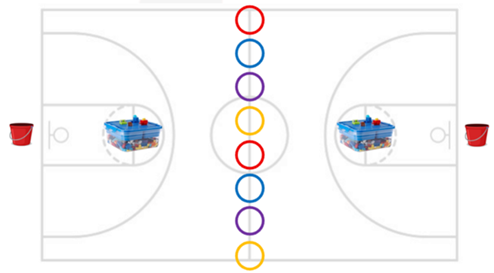
The PA guide included four components. First and foremost, it summarized what was taught in PE that day. For instance, the second lesson for Grade 1-2, a “Rock, Paper, Scissors” game was implemented to practice and refine the eight traveling skills. As illustrated in Figure 1, hula hoops are placed in the middle of the court. Two buckets are placed behind the baselines of the basketball court. Two plastic tubs filled with an equal amount of yarn balls were placed on the free throw lines. On the GO signal, children travel from either baseline, meet a person across the hula hoop, and do a “rock, paper, scissors” battle. Winners grab a yarn ball from the tub on their side and put it in the bucket behind their baseline. Losers run back to their baseline and do five jumping jacks. Once complete the respective task, they can resume play by running up to a hula hoop, meeting an opponent, and do a “rock, paper, scissors” battle. A round ends when one team moves all yarn balls from the tub to the bucket. The instructor calls different traveling skills each round. At the end of this PA guide section, a physical objective (i.e., the definitions of the eight traveling skills) and a social objective (i.e., what does it mean to be a “good loser?” A good loser is someone who accepts defeat in a game without getting upset or angry. They show respect for the winner and the game. They use the opportunity to work on resilience (don’t give up) and personal growth) were provided.
Figure 1
Rock, Paper, Scissors Game Setup
The second component is related skill practice at home. Carrying on the same example described above, a “Listen & Move” video (PE with Coach Smith, 2023) was provided. This video is nine minutes and 43 seconds in length, featuring 11 movements for 25 seconds each with a five-second resting period in between. Children can follow along as the animated creature walks, marches, speed-walks, skips, tip-toes, gallops, crab-walks, skates, jumps, walks like a robot, and jogs with upbeat and matching background music. It includes two rounds of all 11 movements, which could be used to not only practice and refine locomotor (i.e., traveling) skills but improve cardiovascular fitness as well.
The third [DP1] component offered an age-appropriate workout video that focused on at least one area of the health-related physical fitness. Continuing the same example, a “rock paper scissors fitness battle” video (Fitness Hustle TV Kids, 2020) was provided. This video is 11 minutes and 18 seconds in length, but only the first part of the video (00:42 to 5:41) is related to the content taught in the PE class. It contains 10 rounds of rock paper scissors battle with a variety of exercises when a person wins, loses or ties with the robot. Each exercise lasts 17-20 seconds, depending on how fast a person shoots out the fingers. There is a 10-second resting period between rounds.
The last component of the PA guide highlights community resources for the whole family to be physically active as a unit. This component could be highlighting a local park with its facilities and services, a seasonal gathering for a specific PA, or a weekend event following the PE class. For instance, there was a cultural festival where attendees could participate in the traditional dances, ride on a mechanical bull, or complete in a sack race. During the month of October, there was a scarecrow trail at one of the local parks where people could hike the trail and vote for their favorite scarecrow. Park and recreation facilities and services were featured in six of the 10 PA guides, including walking/running trails, basketball courts, pickle ball/tennis courts, soccer fields, baseball/softball fields, disc golf courses, and an outdoor, body-weight training center. All community PA resources included in the guide were free of charge and within 20 miles from downtown except for a national park that was 42 miles from town center.
Data Collection and Analysis
The Physical Activity Survey was created on Qualtrics and consisted of three sections. Section One, Physical Activity Participation of Homeschoolers, included six questions. The first three questions asked the grade level of a child and the frequency (i.e., how many days a week) and duration (in a 30-minute segment from “less than 30 minutes” to “more than 2 hours”) of the child’s PA participation. Question #4 asked if the child participated in an organized sport, which was defined as “a scheduled practice with an instructor or coach, competition is optional.” When parents answered “yes”, they were prompt to Question #5, where 14 sports were listed (i.e., baseball/softball, basketball, cheer/dance, golf, gymnastics, lacrosse, martial arts, rock climbing, running/cross country, skating, swimming, soccer, tennis, volleyball) with a space at the end to specify any organized sports that their children participated in but were not listed. When parents answered “no”, they would skip Question #5 and were prompted to answer Question #6, “Do you have a second child in Grade 1-2 (or Grade 3-8)?” When parents answered “yes”, Qualtrics repeated all questions for the second child and the cycle continued until the parents had no more children enrolled in the specific grade level cluster (i.e., Grade 1-2 or Grade 3-8). When parents answer “no”, Qualtrics took them to the next section.
Section Two, Physical Activity Participation as a Family, included four questions. Question #1 asked if they participated in PA as a family, which was defined as “at least one parent and one child both participate in the activity; it could be practicing certain skills, playing at home or outside, but not from a coaching/supervising position.” When parents answer “yes”, they would answer Question[DP2] #2, where 15 PAs were listed (i.e., baseball/softball, basketball, biking/cycling, bowling, camping, golf, hiking, lacrosse, pickle ball, running/cross country, swimming, soccer, tennis, volleyball, walking) for them to check all that applied and a space for them to type any PA that they participated in as a family but not listed. Question #2 was followed by Questions #3-4, where the duration and frequency of the family’s PA participation were reported. When parents answered “no” on Question #1, Qualtrics took them to the next section.
Section Three, Physical Activity Guide, included four questions. Question #1 asked the parents if they read the PA guide. If the answer was “no”, Qualtrics took them to the end of the survey with a thank-you note. If the answer was “yes”, they were asked if they used any of the information on the PA guide in Question #2. A “no” to Question #2 would take them to the end of the survey, while a “yes” to the same question would prompt them to Question #3 where they ranked the four components (i.e., PE summary, related skill practice, fitness development, community PA resources for the family) from the most useful (4) to the least useful (1). Lastly in Question #4, they were presented with an opportunity to write down anything to include in the future PA guide that would help their children and family to be more physically active.
The survey was sent to the parents who had Grade 1-2 children on the Monday after the conclusion of their PE elective, which was the Monday on week 8. Two email reminders were sent on the following two Mondays (week 9 and 10). The same survey was sent to the parents who had Grade 3-8 children on the Monday after the conclusion of their PE elective, which was the Monday on week 14. Two email reminders were sent on the following two Mondays (the week of Thanksgiving and week 15). Data were entered and analyzed using SPSS 30. Frequencies and percentages were calculated to summarize the response rate, the number of homeschoolers and families, the duration, frequency and type of PAs the homeschoolers and families participated in, and PA guide usage.
Findings
Twenty-two of the 26 parents who had children in Grade 1-2 completed the survey, which was an 84.6% response rate. In comparison, only 17 out of the 25 parents who had children in Grade 3-8 completed the survey, generating a 68% response rate. Survey responses represented a total of 57 subjects in this study, including 15 (26.3%) first graders, 17 (29.8%) second graders, two (3.5%) third and fourth graders each, six (10.5%) fifth and sixth graders each, seven (12.3%) seventh graders, and two (3.5%) eighth graders from 39 households.
Physical Activity Level of Homeschool Children
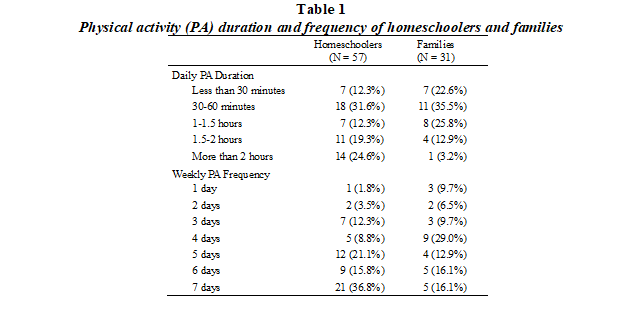
According to the parental self-report data illustrated in Table 1, more than half of the subjects (n = 32, 56.1%) met the daily PA duration recommended by the U.S. Department of Health and Human Services (2018). Almost three-quarters of the subjects (n = 42, 73.7%) engaged in some form of PA at least five days a week. Out of the 57 subjects, 41 (71.9%) participated in organized sports. Baseball/Softball was the most popular organized sports with 13 subjects (18.6%) participating in it, followed by 10 subjects (14.3%) playing basketball and nine (12.9%) in running/cross country. Lacrosse, skating and tennis appeared to be unattractive to the subjects because none of the parents registered their children in it.
Table 1
Physical activity (PA) duration and frequency of homeschoolers and families
Physical Activity Level of Homeschool Families
Out of the 39 parents who responded the survey, 31 reported that they participated in some form of PA as a family (Table 1). It was an encouraging discovery that almost 80% of the surveyed households attempted to be physically active as a family. This type of family functions did not last very long though; more than half of the families (n = 18, 58.1%) were active for 60 minutes or less a day. In terms of the weekly PA frequency, the number of families who participated in PA one to four days a week (n = 17, 54.8%) was similar to the number of families who were physically active five to seven days a week (n = 14, 45.2%). Walking was the most common family PA (n = 26, 23.9%), followed by hiking (n = 17, 15.6%) and swimming (n = 15, 13.8%). Out of the listed PA options, lacrosse and tennis remained the least common PA for the surveyed homeschool families with zero participation. It was interesting to note that working out/weightlifting, fishing and hunting, jumping on trampoline, throwing football, skating and skateboarding were specified as the additional family PAs by the parents.
Perception of Physical Activity Guide
Out of the 39 parents who responded the survey, only 15 (38.5%) read the PA guide. Out of the 15 who read the PA guide, 12 (80%) reported using it. Among the four components, “PE summary” was rated as the most useful resource with nine (75%) high rankings (3 or 4 “the most useful”). “Related skill practice” was perceived to be somewhat useful as 11 of the marks (91.7%) were tallied as ranking of 2 or 3. The parents’ perception regarding the fitness videos was split evenly between the useful and not useful rankings. “Community PA resources for the family” appeared to be the least useful component according to the eight (66.7%) low rankings of 1 and 2.
Discussion
Implication #1: A Need for Homeschool PE
The findings of this research indicate the importance of PE and the need to include PE as part of the homeschool curriculum. First, almost half of the homeschoolers in this study failed to participate in PA at least 60 minutes every day. Had PE become a mandatory subject “in school” where homeschoolers play outside or count organized sports as part of their daily PA, they could easily meet the duration guideline since their daily schedule is much more flexible than the rigid schedule at public schools. Second, the concept of MVPA and physical fitness components could be taught as part of the PE units, through which homeschoolers would be able to start developing physically active habits from a young age, slowly explore different PAs, and find one or a few that they enjoy participating in to set goals, monitor progress, and prevent injury. As they grow older, the knowledge and skills to maintain a balanced fitness level become essential to live a quality life. Lastly, including PE as part of the homeschool curriculum would help collect fitness data that are very much limited from this student population. Unlike students in most public schools, homeschoolers do not conduct Fitnessgram assessments (Meredith & Welk, 2007) in the beginning and at the end of a school year, which makes it difficult to track their fitness levels objectively. Another benefit of conducting fitness assessments is that the results can be obtained to praise good performance and address weaknesses for improvement.
Implication #2: Potential Collaboration with PETE Programs
The finding of “what we learned in PE today” being the most valuable information on the PA guide indicates the parents’ interest in the PE content rather than seeing PE as a time for free play. Combined with perceiving “related skill practice/drills” as somewhat useful makes the author speculates that the parents care about PE but are hesitant to provide further instruction at home. This speculation stimulates a proposition for teacher training, which in this case means training parents or co-op leaders to teach PE. Homeschool parents are encouraged to request collaboration with PETE programs in higher education. This collaboration could hit two birds with one stone as undergraduate PE majors could use homeschool PE as their clinical experience before student-teaching while homeschool families could find a way to receive quality PE for their children and learn to deliver PE on their own. Workshops that teach homeschool parents or co-op leaders how to teach and manage small groups of homeschoolers in an open space are also beneficial to those who are up for the challenge. It is almost impossible to expect a homeschool parent to earn a degree in PE or do extensive research on how to deliver a quality PE lesson. Therefore, materials similar to the PA guide presented in this study become practical. The “related skill practice/drills” and fitness videos are PAs that the PE instructor found to make individual work possible. Without being in a group setting to play games or compete with one another, homeschoolers can practice and refine motor and sports-related skills in isolation and work on self-efficacy for their own good.
Implication #3: Value of the Social Environment
Out of the 57 subjects, more than a quarter (n = 16, 28.1%) did not participate in organized sports. Having the opportunity to host homeschool PE programs at her institutions for seven years and counting, the author has received positive comments about the social environment more than anything. Being part of an organized sport certainly provides the social fulfillment, but not every family can afford registering their children in one. There are many ways that homeschool parents could involve their children with like-minded families in social settings. Initiating a homeschool PA club as a gathering where homeschoolers learn to play a sport or participate in a PA could be a good start. This PA club could easily be, for example, a basketball pick-up game, a bike ride in a safe neighborhood, a camping trip or a hike that integrates outdoor or environmental education (Chen & McCreary, 2025; Chen et al., 2024). As a culminating event, homeschool families could get together for a friendly competition. For instance, a pickle ball tournament that has parent-child teams playing against each other would be a good motivation to stimulate greater daily PA and family bonding time, which will address the low PA time and frequency as a family found in the present study. As a group, families could decide to keep it going or switch to another PA/sport as time progresses. This PA club should be promoted as a physically active lifestyle, not an obligation to participate.
Conclusion
This research aimed to examine the PA level of homeschoolers and their families as a unit and perception of the weekly PA guide provided as a supplemental resource of a PE elective at a homeschool co-op. Parental self-reported data indicated that more than half of the surveyed homeschoolers were physically active more than 60 minutes a day for more than five days a week. Baseball/Softball, basketball and running were the top three popular organized sports they participated in on a regular basis. As a family, more than half only engaged in PA 60 minutes or less on four days or less a week. The top three family PAs were walking, hiking and swimming. As for the PA guide, less than one-third of the surveyed parents read and used it; however, for those who used it, they valued what their children learned in PE and appreciated the fitness videos that their children could watch and be active at home, although they were hesitant about giving further PE-related skill practice at home. The author offered three practical implications in the earlier section. The propositions to include PE in homeschool curriculum, invite parents and co-op leaders to learn about quality PE planning and implementation, and initiate a homeschool PA club could be optimal strategies to combat the obesity crisis.
This research is limited to a small sample size – 57 children and adolescents from 31 homeschool households at a mid-eastern state in the United States. Generalization of these results to other homeschool populations should be taken carefully. Another limitation is the self-report survey data. Potential biases such as recall and social desirability may be taken into consideration. A third limitation comes from the invalidated survey instrument. Directions for future research are to, first, conduct a survey validation process, and once validated, collect survey and interview data from a much larger sample size while controlling for potential biases.
It is the author’s hope that this pilot study will indicate a need or a challenge. If homeschool families believe there is a need, a follow-up study could examine homeschool parents’ interests in teaching structured PE to their own children or at a homeschool co-op. If they believe that PE is not important enough to be included as one of the subjects (core or elective) in the curriculum, a follow-up study investigating the why’s is warranted, particularly using a qualitative research method to get a text-rich dataset. Regardless, the results of this pilot study would help PE advocates discover what they could be of assistance, whether it is to teach PE side-by-side with a parent, create a workshop for co-op leaders, or distribute a PA guide with greater details. In sum, the knowledge and skills children and adolescents learn from PE can be used for their lifetime. A collaboration between PE advocates and homeschool families would serve as a potential for a greater good.
References
American Heart Association. (2024). Target heart rates chart. https://www.heart.org/en/healthy-living/fitness/fitness-basics/target-heart-rates
Chen, Y., & McCreary, A. (2025). The impacts of environmental education on homeschoolers’ attitudes toward nature. Journal of Adventure Education and Outdoor Learning, 25(1), 84-99. https://doi.org/10.1080/14729679.2024.2372395
Chen, Y., McCreary, A., & Stenger-Ramsey, T. L. (2024). Effectiveness of an outdoor education program with homeschool students. Journal of Outdoor Recreation, Education, and Leadership, 16(1), 55-66. https://doi.org/10.18666/JOREL-2023-11950
Fitness Hustle TV Kids. (2020). Rock paper scissors fitness battle . https://youtu.be/RNDVYrViBmQ?si=a6Fu2LrOPajxFNbQ
Kabiri, L. S., Butcher, A., Brewer, W., & Ortiz, A. (2020). Youth physical health and years in American homeschools: Are they related? Health Promotion International, 35(3), 512-517. https://doi.org/10.1093/heapro/daz047
Kabiri, L. S., Mitchell, K., Brewer, W., & Ortiz, A. (2018). How healthy is homeschool? An analysis of body composition and cardiovascular disease risk. Journal of school Health, 88(2), 132-138. https://doi.org/10.1111/josh.12588
Kabiri, L. S., Rodriguez, A. X., Perkins-Ball, A. M., & Diep, C. S. (2019). Organized sports and physical activities as sole influencers of fitness: The homeschool population. Journal of Functional Morphology and Kinesiology, 4(1), 13. https://doi.org/10.3390/jfmk4010013
Kentucky Department of Education. (2025). KY Academic Standards. https://kystandards.org/home/ky-acad-standards/
Meredith, M. D., & Welk, G. J. (Eds.). (2007). Fitnessgram®/Activitygram®: Test administration manual (4th Ed.). The Cooper Institute.
PE with Coach Smith. (2023). Locomotor listen & move . https://youtu.be/1hqUuLriFWU?si=sSYMSxqlxM1KAeKe
Sappenfield, O., & Hirai, A. (2025). Healthy behaviors among school-aged children, 2024. Health Resources and Services Administration. https://mchb.hrsa.gov/sites/default/files/mchb/data-research/nsch-data-brief-healthy-behaviors-school-aged-children-2024.pdf
U.S. Department of Health and Human Services. (2018). Physical activity guidelines for Americans (2nd ed.). https://odphp.health.gov/sites/default/files/2019-09/Physical_Activity_Guidelines_2nd_edition.pdf
Wachob, D. A., & Alman, R. E. (2015). Parental influence on the cardiovascular health and body composition of homeschool children. International Journal of Child and Adolescent Health, 8(3), 305-311. ¯