
Brian D. Ray, Ph.D.
Braden Hoelzle, Ph.D.
Douglas Pietersma, Ed.D.
National Home Education Research Institute (NHERI)
February 27, 2026
Copyright © 2026 by National Home Education Research Institute
Abstract
The purpose of this study is to estimate the number of homeschool students in the United States during the 2024-2025 academic school year. The estimate is derived by establishing the size of the nationwide school-age population, ascertaining the percentage of all students that were homeschooled, and assuming a level of underrepresentation of homeschooling in the data that represent the portions of all students who were homeschooled. Homeschool registration and enrollment data from 23 diverse states and data from the U.S. Census Bureau’s Pulse Survey are used. The conclusion is that there were an estimated 3.408 million school-age (K-12) homeschool students in the United States during the 2024-2025 school year (range: 3.067–3.749 million). This is an estimated 6.262% of the school-age population. This figure reflects a notable post-pandemic increase, roughly double Catholic school enrollment (1.684 million) and nearing public charter school levels (3.784 million) during 2024-2025.
Keywords: homeschooling, home education, homeschoolers, population size, numbers, statistics, growth, United States, K-12
Introduction and Purpose
Parent-directed home-based education (homeschooling) was the norm before 1900 in the United States but had nearly gone extinct by the 1970s (Lines, 1991; Ray, 2021a). During the 1980s and 1990s, the homeschool population grew very rapidly. Many want to know now, how many kids are homeschooled today?
Lines (1991) estimated that there were some 13,000 homeschool students in the late 1970s in the United States. The United States Department of Education (USDE) (2021a) reported that about 3.3% of school-age children (“5- to 17-year-olds,” p. 58), or 1.690 million, were homeschooled by the spring of 2016, and found that this was not significantly different from their estimate, four years earlier, of 3.4%.[1] However, using different methods, Ray (2021b) estimated that there were over two million K-12 homeschool students during the spring of 2016, and then estimated 2.6 million during March of 2020 (Ray, 2021c), 3.721 million for 2020-2021 (Ray (2021b; see also: Duvall, 2022; Houston, Peterson, & West, 2022; McDonald, 2021 ), and then down to 3.135 million for the 2021-2022 school year (Ray, 2022).
The purpose of this study is to build on Ray’s (2021b, 2022) and others’ work and arrive at an estimate of the number of K-12 homeschool students in the United States during the 2024-2025 academic school year. That is, how many homeschoolers are there in the U.S.? In sum, the estimate will be derived by establishing the size of the nationwide school-age population, ascertaining the percentage of all students that were homeschooled – assuming a level of underrepresentation of homeschoolers in the data. Relevant data for the size of the total student population and for portions home educated come from multiple sources.
It is challenging to find consistent data on how many total school-age children (approximately ages 5 to under 18), in all schooling sectors (public school, private school, and homeschool), there are in the United States. The United States Census Bureau (USCB) (2026) reported that there were 54,417,758 on July 1, 2024, and that date is close to the beginning of the school year (2024-2025) for which this study is estimating homeschool numbers. This number is used in this study as the basis of the best estimate for the number of K-12 students in the United States. In past research, Ray (e.g., 2022) relied to some degree on statistics from the USDE but their current data sheets appear to be out of date and not reliable (e.g., USDE, 2022) and will not be used here.
Methods
The primary sources of data for this analysis are the United States Census Bureau (USCB) (2024, 2026) and data from all state-level departments of education with relevant publicly available data (see list below). Various states gather and summarize data on the number of homeschool students in their states. Whether they do so, depends partly on whether the state government has any motivation or incentive to report such data and on the state laws that do or do not address homeschooling. In some states, parents are free to privately homeschool without state controls and in other states the government exerts much control and regulation over private home-based education. Whether a state exerts much or little control over private homeschooling is not necessarily correlated with whether the state government collects and disseminates data or statistics on homeschooled students.
For this project, the authors were able to secure usable data from 23 states (i.e., Arkansas, Delaware, Florida, Georgia, Louisiana, Maine, Maryland, Massachusetts, Minnesota, Mississippi, Montana, Nebraska, New Mexico, North Carolina, North Dakota, Ohio, Pennsylvania, Rhode Island, South Carolina, South Dakota, Virginia, Washington, and Wisconsin; see Table 1).[2] Various state laws define school age differently. The data in the table represent what the state counts as homeschool students. This would typically not include public-school-at-home programs (e.g., independent study) or public charters schools that include some instruction at home. And it might not include private or public hybrid schooling or private micro-schooling. These states are not all of the 50 states but they do represent all four major regions of the United States. However, the data cannot be fully integrated since various states’ laws define differently what is school age.
The USCB began, in their Phase 3.2 questionnaire that was first administered during July of 2021, to ask adults how many public school, private school, and homeschool (“… that is not enrolled in public or private school”) students there were in each household. The survey does not mention public charter school, hybrid school, or micro-school. USCB explains the limitations of their survey. No other primary sources of data could be found to inform the estimate in this study.
Homeschool population size comments or estimates by EdChoice (e.g., 2025a, 2025b) and Johns Hopkins University School of Education Institute for Education Policy Homeschool Hub (e.g., 2025) homeschool policy center were considered. Their estimates and comments did not provide any primary-source data or information that would reliably facilitate our estimate. Original research estimates for 2024-2025 by other entities or scholars were not found.
Findings
The USCB data showed that of all school-age children for the 2024-2025 school year, 83.016% were enrolled in public school, 10.453% were enrolled in private school, and 6.530% were homeschooled (United States Census Bureau, 2024, October 3). The survey item does not mention public charter school, hybrid school, or micro-school and the data do not specify numbers of students in these forms of schooling.
On the other hand, the 23-state weighted mean (i.e., weighted by the number of homeschool students per state and the overall school-age population of the state from USCB, 2026) indicated that 4.18% of these states’ school-age children were homeschooled (Table 1). It should be noted that compulsory school ages in some states do not include ages 5, 6, and 17; across the states and District of Columbia, roughly 11% of K-12 (13 school-age years) are not compulsory (United States Department of Education, 2021b, 2021c), and in most states a home-educated child is not require to be registered outside of compulsory school attendance ages. Therefore, the number of school-age (i.e., 5- through 17-year-olds) homeschool children is underrepresented in such states. In addition, some families do not register their children or submit evaluation information regardless of whether state law requires it. For example, West Virginia state officials reported a compliance rate of about 60% for submission of required assessments (e.g., Jenkins, 2024). Further, in some states, homeschool students are listed under private or umbrella schools and do not appear on official rolls as homeschooled.
Table 1. Homeschooling as a percent of all students.
| Source | Number of Homeschool Students, 2024-2025 | Homeschool as Percent of all students* |
| NC | 165,243 | 9.47 |
| SD | 11,489 | 7.02 |
| AR | 35,419 | 6.79 |
| US Census Bureau** | N/A | 6.53 |
| ME | 11,785 | 6.31 |
| MS | 24,725 | 4.94 |
| GA | 89,510 | 4.71 |
| SC | 39,767 | 4.65 |
| NE | 16,419 | 4.57 |
| FL | 152,871 | 4.54 |
| VA | 62,763 | 4.48 |
| MT | 7,661 | 4.35 |
| 23 states, weighted mean | N/A | 4.18 |
| MD | 42,151 | 4.13 |
| ND | 5,009 | 3.68 |
| WI | 31,094 | 3.34 |
| NM | 11,383 | 3.34 |
| LA | 26,019 | 3.31 |
| MN | 31,216 | 3.21 |
| OH | 53,051 | 2.76 |
| DE | 4,246 | 2.67 |
| WA | 30,387 | 2.46 |
| PA | 44,692 | 2.28 |
| RI | 3,086 | 2.03 |
| MA | 12,203 | 1.21 |
Notes:
* For the individual states, these are non-weighted percentages. The table is sorted by percent homeschooled. The baseline number of K-12 school-age children for each state is from https://www.census.gov/quickfacts/ (retrieved January 3, 2026), persons ages 5 through under 18 as of July 1, 2024.
** United States Census Bureau. (2024, October 3). Phase 4.2 Cycle 09 Household Pulse Survey: August 20 – September 16 [2024]. Retrieved 1/22/2026 from https://www.census.gov/data/tables/2024/demo/hhp/cycle09.html (includes: Education Tables xls.svg Table 1. School Enrollment Type for Children in Kindergarten to Twelve Grade, by Select Characteristics). Reports percentages but not total numbers for the United States.
Since the actual number of nationwide homeschool students has not been recorded and therefore cannot be calculated, the estimated number of homeschool students can be reached by estimating both the total number of school-age students and the percentage of those students who are homeschooled.
Further, nationwide estimates of percentages and actual student counts by the USDE and USCB have many limitations. At the state level, however, homeschool registration and enrollment numbers are more tangible and consistent and not based on the limited response rates and unknown representativeness of the federal national surveys.
Most of the calculations with data that preceded the presentation of numbers and decimals above were done at 3 or more decimals before rounding to the decimal places shown in this report.
Not all students who are homeschooled are accounted for by state departments of education and homeschool parents are less likely than institutional school parents to respond to government or other researchers’ survey questions about the nature of their children’s education and schooling (Treleaven, 2022). For researchers, homeschoolers are a hard-to-reach population. Further, as noted above, roughly 11% of 13 school-age years are not compulsory in the United States.
The wording of the USCB survey questions does not separate out (for the adult respondents) the categories of public charter schools and other tax-funded school-at-home programs. It is the experience of the authors that a notable portion of families in these government programs self-identify as homeschooling. This likely causes homeschooling to be somewhat overrepresented regarding definitions in the USCB data but perhaps still somewhat underrepresented regarding not covering some of the 13 school-age years.
Therefore, it was assumed (for this study, and being consistent with Ray, 2022) that the number of homeschool students is disproportionately underrepresented by 20% in state-level data-collection systems, and disproportionately underrepresented by 15% in the USCB survey data system. Future research might specifically address the underrepresentation question and provide a better estimate of the portion.
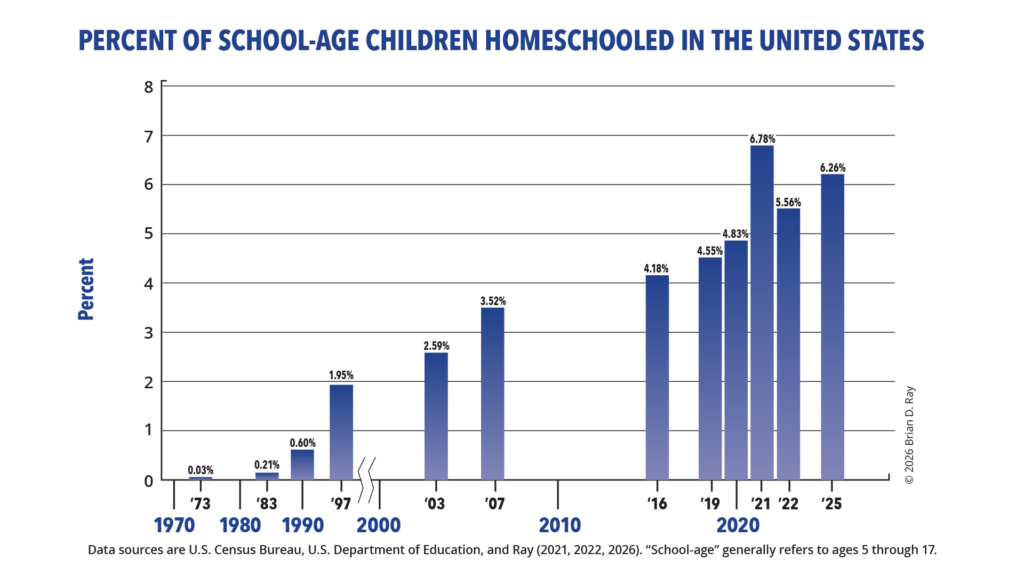
With the 20% underrepresentation adjustment, the 23-state weighted mean percent of school-age children (4.180%) for Spring of 2025 would be 5.016%. With the 15% underrepresentation adjustment, the USCB homeschool number (6.530%) would be 7.509% of the school-age population for 2024-2025. Considering the limitations and challenges of both state and federal government agencies gathering data on homeschool students, it is difficult to know which of these two statistics regarding the homeschool school-age population is closer to representativeness. The mean of the two is 6.262%.
Figure 1 shows the growth of the number of homeschool students in grade levels K-12 in the United States from the 1970s through 2025. Figure 2 presents homeschooling as an estimated percentage of the K-12 school-age population over time.
Based on the estimates of 6.262% and 54,417,758 total school-age children in the United States, there were an estimated 3.408 million school-age (K-12) homeschool students in the United States during the 2024-2025 school year. A reasonable range estimate (+/- 10%) would be, therefore, 3.067 million to 3.749 million during 2024-25.
Figure 1.
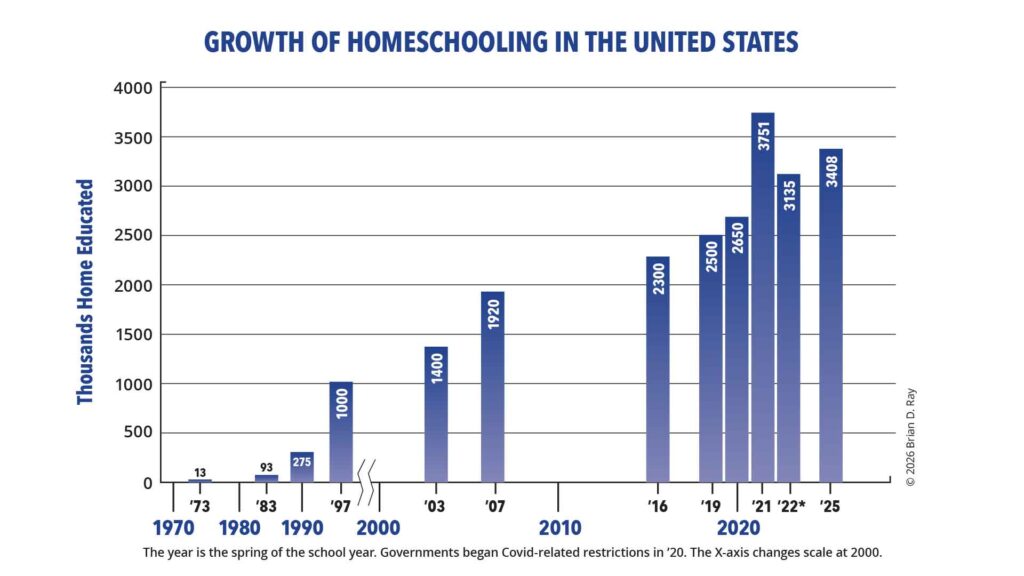
Figure 2.
Conclusion
There have been widely varying estimates regarding the number of homeschool students in the United States during the past few years (e.g., Duvall, 2022; McDonald, 2021; Ray, 2021b; USCB, 2021). What is the true parameter, the most accurate number, to answer the question, “how many kids are homeschooled” or “how many homeschoolers are in the US”? Laws, reporting regulations, methods of reporting, and the proclivity of homeschooling parents to answer surveys about their children vary across the nation but the state-level data used in this study have a solid level of reliability and history. Many of the states have been collecting data on the number of registered homeschool students for more than a decade. The reliability of the data from the USCB appears to be stabilizing. This inquiry has been a robust effort to use a variety of the best sources of up-to-date and available data.
This analysis leads to the following answer: There were an estimated 3.408 million homeschool students (i.e., school-age, ages 5 to under 18, K-12) in the United States during the 2024-2025 school year. For context, this about double the number in Catholic schools (1.684 million; National Catholic Educational Association, 2025) and probably somewhat fewer than in government public charter schools (3.784 million in 2023-2024; National Alliance for Public Charter Schools, 2025).
Five years ago, Ray (2021b) predicted the following:
“The remarkably higher numbers in the homeschool population during the spring of 2021 compared to the spring of 2020 will likely subside (e.g., Nitcher, 2021), but not completely. Many observers expect the number of homeschool students during the 2021-2022 conventional school year to remain significantly higher than during 2019-2020 because more families, both parents and children, experienced the benefits of parent-directed home-based education during the government restrictions on schools during the past two school years. The growth in homeschooling will also continue due to the other stable reasons for homeschooling that have motivated parents over the past 40 years …”
So far, the prediction has turned out to be true. Although the homeschool student population in the United States declined from 2020-2021 to 2021-2022, the upward trend of the past 40 years continued after that year into 2024-2025.
References
Duvall, Steven. (2022, April 12). Homeschool surge still going strong, https://hslda.org/post/homeschool-surge-still-going-strong
EdChoice. (2025a). 2025 EdChoice Share: Exploring Where America’s Students Are Educated, https://www.edchoice.org/2025-edchoice-share-exploring-where-americas-students-are-educated/
EdChoice. (2025b). The Public, Parents, and K–12 Education National Polling Report #60, https://edchoice.mcdatahub.com/edchoice/Reports/Adults_Dec_Jan_25.pdf
Houston, David M.; Peterson, Paul E.; & West, Martin R. (2022). Parental anxieties over student learning dissipate as schools relax anti-Covid measures, https://www.educationnext.org/parental-anxieties-over-student-learning-dissipate-as-schools-relax-anti-covid-measures-2022-education-next-survey-public-opinion/
Jenkins, Jeff. (2024). School administrators call for more accountability from homeschool families, https://wvmetronews.com/2024/09/18/school-administrators-call-for-more-accountability-from-homeschool-families/
Johns Hopkins University, Institute for Education Policy, Homeschool Hub [Angela Watson]. (2025). Homeschool growth: 2024-2025, https://education.jhu.edu/edpolicy/policy-research-initiatives/homeschool-hub/homeschool-growth-2024-2025/
Lines, Patricia M. (1991, October). Estimating the home schooled population (working paper OR 91-537). Washington DC: Office of Educational Research and Improvement, U.S. Department of Education.
McDonald, Kerry. (2021). New census data show homeschooling tripled during the pandemic—and one key group is driving the surge. Retrieved September 6, 2021 from https://fee.org/articles/us-census-homeschooling-triples-diversifies-during-pandemic-response/
National Alliance for Public Charter Schools. (2025). Nationwide, school year 2023-24, https://data.publiccharters.org/
National Catholic Educational Association. (2025). Catholic schools by the numbers: New data reveals trends in enrollment, staffing and student demographics, https://ncea.org/NCEA/NCEA/How_We_Serve/News/Press_Releases/Catholic-Schools-by-the-Numbers-New-Data-Reveals-Trends-in-Enrollment-Staffing-and-Demographics.aspx
Nitcher, Emily. (2021). Number of Nebraska students enrolled in home schooling down from last school year. Retrieved September 7, 2021 from Omaha World-Herald, https://omaha.com/news/local/education/number-of-nebraska-students-enrolled-in-home-schooling-down-from-last-school-year/article_2b9d8174-0a99-11ec-ac9c-97b0da23de51.html
Ray, Brian D. (2021a). An overview of the worldwide rise and expansion of home education homeschooling (chapter 1). In Rebecca English (Ed.), Global perspectives on home education in the 21st century. Hershey, PA: Information Science Reference (an imprint of IGI Global).
Ray, Brian D. (2021b). How many homeschool students are there in the United States? Pre-Covid-19 and post-Covid-19: New data, https://www.nheri.org/how-many-homeschool-students-are-there-in-the-united-states-pre-covid-19-and-post-covid-19/
Ray, Brian D. (2021c). Research facts on homeschooling, https://www.nheri.org/research-facts-on-homeschooling/
Ray, Brian D. (2022). How many homeschool students are there in the United States during the 2021-2022 School Year?, https://nheri.org/how-many-homeschool-students-are-there-in-the-united-states-during-the-2021-2022-school-year/
Treleaven, Lisa M. (2022). Quantitative insights into the academic outcomes of homeschools from the Classic Learning Test. Home School Researcher, 38(1), 1-13, https://nheri.org/quantitative-insights-into-the-academic-outcomes-of-homeschools-from-the-classic-learning-test/
United States Census Bureau. (2021). American Community Survey, response rates. Retrieved September 9, 2021 from https://www.census.gov/acs/www/methodology/sample-size-and-data-quality/response-rates/
United States Census Bureau. (2024). Phase 4.2 cycle 09 Household Pulse Survey: August 20 – September 16 [2024] (includes, “Education tables xls.svg, table 1. school enrollment type for children in kindergarten to twelve grade, by select characteristics). Retrieved January 22, 2026 from https://www.census.gov/data/tables/2024/demo/hhp/cycle09.html
United States Census Bureau. (2026). Quick facts: United States. Retrieved January 23, 2026 from https://www.census.gov/quickfacts/
United States Department of Education. (2021a). Back-to-school statistics. Retrieved September 8, 2022 from https://nces.ed.gov/fastfacts/display.asp?id=372#PK12-enrollment
United States Department of Education. (2021b). Compulsory school attendance laws, minimum and maximum age limits for required free education, by state: 2017. retrieved 9/6/21 from https://nces.ed.gov/programs/statereform/tab5_1.asp
United States Department of Education. (2021c).Digest of Education Statistics 2019, 55th Edition, February 2021. Retrieved September 2, 2021 from https://nces.ed.gov/pubs2021/2021009.pdf
United States Department of Education. (2022). Fast facts: Back-to-school statistics, https://nces.ed.gov/fastfacts/display.asp?id=372#PK12-enrollment
United States Department of Education. (2022). Table 105.30. Enrollment in elementary, secondary, and degree-granting postsecondary institutions, by level and control of institution: Selected years, 1869-70 through fall 2031, https://nces.ed.gov/programs/digest/d22/tables/dt22_105.30.asp
[1] The term significant typically means statistical significance in this paper.
[2] Data were also obtained for Colorado and Oregon. However, the Colorado state-collected data do not include large portions of homeschool families who do not need to report to the state and Oregon’s data are comprised of only first-time registrations of individual children.