
Douglas Pietersma, Ed.D.
Brian D. Ray, Ph.D.
National Home Education Research Institute (NHERI)
September 12, 2026
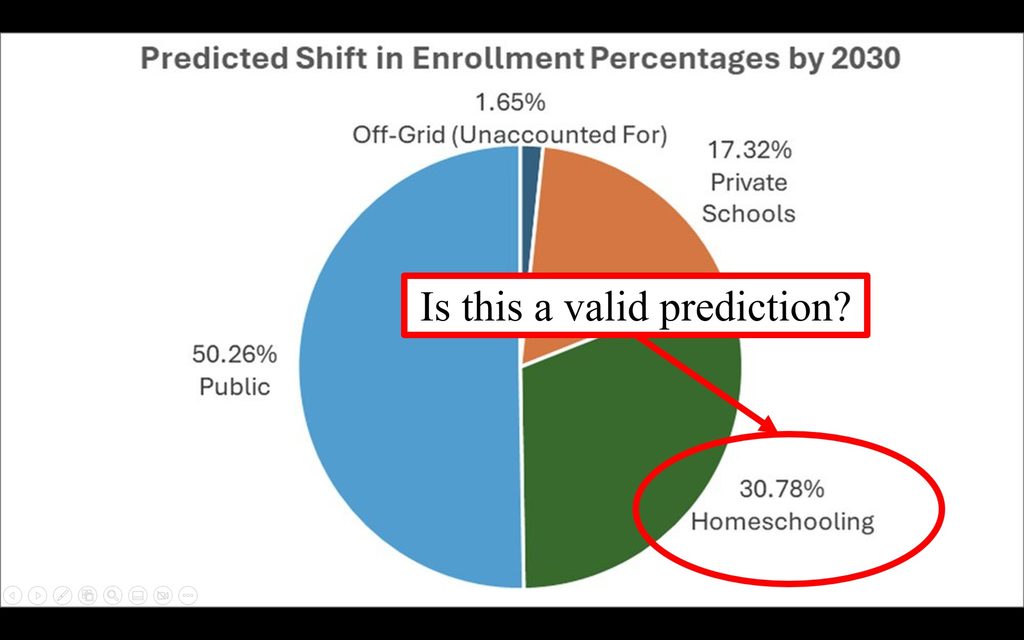
Facts, figures, and predictions about home education should be accurate, valid, and reliable. Supporters and critics of home education alike should agree on that.
As researchers, if we see a data point, conclusion, or assessment, we naturally want to ask questions such as: How did they get those data? What support exists for that conclusion or assessment? What was the theoretical framework behind the study? This is not to be overly critical (in the negative sense of the word) but to make sure that information we share is reliable and valid.
There is a graphic making the rounds on social media sites that purports to “predict” that by 2030 the population of homeschooled students will reach 20 million in the United States, comprising 30% of the school-aged children. See the image on this article, with our “warning label” added to it.
Many supporters of homeschooling would be delighted to see that level of growth. But a desirable prediction is not necessarily a reliable prediction.
Consider that the current estimate (2024-2025 school year) for the home educating population—by us at the National Home Education Research Institute—is approximately 3.4 million. You can read here about how we calculated that estimate, including the methods and assumptions used.
How do we go from about 3.4 million to 20 million homeschool students in only six years? That would require the homeschool population to increase nearly six-fold—roughly 34% per year compounded for six consecutive years. Seeing such substantial numbers made us wonder about their source, calculation, and ultimate validity and reliability. We tracked down the source of the graphic to a 2024 online article published by The Learning Counsel (entitled, “The future of K12 education, so you can prepare for it: Public education is set to lose 16 million enrollments by 2030”).
The bottom line is that this is not a scholarly predictive analysis. This does not mean that 20 million homeschool students by 2030 is impossible; it means that the materials presented do not provide a sufficiently transparent and reproducible basis for concluding that it is likely.
We contacted The Learning Counsel and requested additional information about the methods behind its predictions. The materials provided do not adequately document several elements we would expect in a rigorous scholarly forecast: (a) a sufficiently developed theoretical framework tied to measurable variables, (b) methods detailed enough to make the analysis replicable, (c) a clear explanation of how the quantitative analyses and projections were produced, and (d) a transparent connection between the underlying data, findings, and conclusions.
Whether a human, AI, or both produced the materials is not our concern; what matters is whether the claims are methodologically supportable.
Predictive analysis is one of the hardest forms of analysis to do well because it requires identifying the important variables, stating assumptions, and explaining how the evidence produces the forecast. For this article and its associated graphics, we could not find an accessible dataset, a clearly specified forecasting model, sufficiently documented procedures for assigning and combining the trend weights, model validation or sensitivity analysis, a clear quantification of uncertainty, or a reproducible procedure by which independent researchers could generate the same or similar forecast. In short, from a research perspective, it remains unclear how the specific numbers were produced, so we cannot establish their reliability or validity.
Operational definitions also matter. The graphic simply says “homeschooling,” while the accompanying article acknowledges using “…a rather loose definition…” that may encompass educational arrangements that other researchers would classify differently. NHERI, for example, defines home education as “parent-controlled home-based privately funded private education” (Ray, 2025).
To be fair, the main point of the article by The Learning Counsel was to point out how much public education would lose in population by the specified date, but many home education advocates, influencers, and support organizations have shared this graphic highlighting its prediction of a drastic increase in homeschooling. We want everyone—whether supporters or critics of homeschooling—to look for solid and reliable information and use it wisely.
Well-done research (“What is ‘good’ research,” Ray, 2020) does not fear being questioned. In fact, it should welcome questioning in order to help make current assessments clearer and future studies stronger. When necessary, questioning helps to correct faulty assumptions, make clear the limitations of research, and strengthen the validity of future research.
If you have any questions or concerns about a new research study, graph, chart, or meme, please contact us at the National Home Education Research Institute (NHERI). We would like to help.
References
Ray, Brian D. (2020). What is “good” research? A homeschool researcher responds to Harvard professor’s criticism: Research Methods 101. https://nheri.org/what-is-good-research-a-homeschool-researcher-responds-to-harvard-professors-criticism/
Ray, Brian D. (2025). Defining homeschooling and why it matters. https://papers.ssrn.com/sol3/papers.cfm?abstract_id=5211580
Supporting this unique research think tank is good: NHERI has been serving the public for over 35 years — support the work.
# # #